Should Christians Really Celebrate Christmas?
Christmas is one of the most widely celebrated holidays in the world, yet one of the most misunderstood among Christians. Many believers assume that celebrating the birth of Jesus on December 25th is a biblical tradition, but few have ever examined what Scripture actually says about this holiday, its origins, or the customs surrounding it. Does the Bible command Christians to celebrate Jesus’ birth? Does God approve of man‑made religious holidays? And what about the many traditions—trees, lights, Santa Claus, gift‑giving—that have become central to the season?
This study goes directly to the Word of God to answer these questions honestly and without tradition. The goal is not to attack anyone’s sincerity, but to help Christians “prove all things” (1 Thessalonians 5:21) and understand whether Christmas aligns with God’s will—or opposes it. Many believers are surprised to discover that Scripture speaks far more clearly about pagan customs, man‑made festivals, and religious traditions than they ever realized.
For example, the Bible warns strongly against lying—even “innocent” lies told to children about Santa Claus. It also condemns religious festivals God did not command, saying, “Your appointed feasts My soul hates” (Isaiah 1:14). And while many Christians assume Christmas honors Jesus, the early church never celebrated His birth, and the holiday itself was built on pagan foundations that long predate Christianity.
So what does the Bible really say about Christmas? Should Christians celebrate it? Or does God call His people to something very different? Let’s examine the Scriptures carefully and discover the truth.
Does the Bible Command Christians to Celebrate Christmas?
This is the starting point for every sincere believer: What does the Word of God actually command? Many Christians assume Christmas is a biblical celebration simply because it is popular, sentimental, and long‑standing. But popularity does not make something biblical. Tradition does not make something true. And sincerity does not make something right.
When we search the Scriptures, we find something surprising: there is no command, example, or instruction anywhere in the Bible to celebrate the birth of Jesus. Not one verse tells Christians to observe His birthday. Not one apostle celebrated it. The early church never practiced it. And Jesus Himself never taught it.
In fact, the only birthday celebrations mentioned in Scripture are pagan ones—and both are associated with sin (Genesis 40:20–22; Matthew 14:6–10).
If God wanted His people to celebrate the birth of His Son, He would have commanded it clearly. Instead, He commanded something else entirely:
“Prove all things; hold fast that which is good.” (1 Thessalonians 5:21)
Before embracing any religious practice, God calls His people to test it, examine it, and compare it to Scripture—not culture.
Does God Approve of Man‑Made Religious Holidays?
Many Christians assume that as long as a holiday is “for Jesus,” God must accept it. But Scripture teaches the opposite. He repeatedly condemns religious festivals that He did not command, even when people claim to celebrate them in His honor.
“Your New Moons and YOUR appointed feasts My soul hates.” (Isaiah 1:14)
Notice the emphasis: your feasts—not God’s feasts. God distinguishes between:
- His appointed festivals (Leviticus 23), and
- man‑made religious holidays.
Christmas is not found in Leviticus 23. It is not found anywhere in Scripture. It is a man‑made religious holiday built on traditions God never authorized.
Response to unauthorized worship is consistent throughout the Bible: The Lord rejects it. He does not accept worship invented by human imagination, no matter how sincere the intention.
This is why Jesus warned:
“In vain they worship Me, teaching as doctrines the commandments of men.” (Mark 7:7)
If God hates man‑made religious festivals, then Christians must seriously consider whether Christmas—no matter how sentimental—honors God or opposes Him.
Are Christmas Traditions Rooted in Pagan Customs?
The modern Christmas celebration is filled with customs that did not originate in Scripture. Evergreen trees, wreaths, mistletoe, gift‑giving, Yule logs, December 25th, feasting, lights, and even the “Christmas spirit” itself all trace back to ancient pagan religions—especially those honoring the sun god during the winter solstice.
The Bible warns people not to adopt pagan customs, even if they attempt to repurpose them for worship.
“Do not learn the way of the heathen.” (Jeremiah 10:2)
God does not say, “Use pagan customs for Me.” He says, “Do not learn them.”
Even the Christmas tree—central in many Christian homes and churches—has roots in pagan worship. And Scripture gives a direct warning about placing trees near the altar:
“Thou shalt not plant thee a grove of any trees near unto the altar of the Lord thy God.” (Deuteronomy 16:21)
While this verse refers to pagan groves used in idolatry, the principle remains: God does not want pagan symbols mixed with His worship. Yet many churches place decorated trees directly beside their pulpits and altars every December.
If the source of a tradition matters to God, and Scripture says it does, then Christians must reconsider whether these customs honor Him or offend Him.
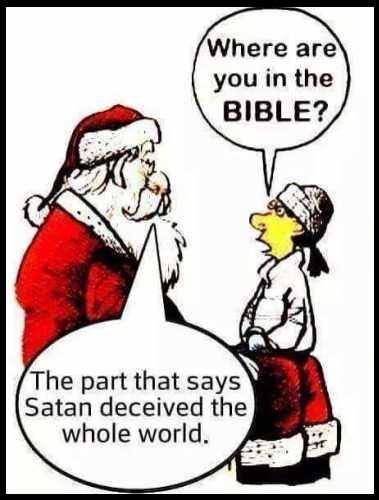
Is It a Sin to Tell Children That Santa Claus Is Real?
Many Christians treat Santa Claus as harmless fantasy, but Scripture does not treat lying as harmless. The ninth commandment forbids bearing false witness, and God never makes exceptions for “fun,” “tradition,” or “childhood magic.”
“A false witness will not go unpunished.” (Proverbs 19:5)
When parents tell their children that Santa Claus is real—that he sees them, knows their behavior, and rewards them accordingly—they are teaching a lie. Worse, they are creating a counterfeit god‑figure who imitates divine attributes.
Children trust their parents. When they eventually discover that Santa is not real, many begin to question whether Jesus is real. If their parents lied about one unseen figure, why not the other?
This is not harmless. It damages trust and confuses spiritual truth.
Sin is still sin, even when wrapped in holiday sentiment.
Does God Warn Against Using Pagan Customs in Worship?
One of the strongest themes in Scripture is God’s absolute rejection of pagan customs being mixed with His worship. God repeatedly warns His people not to adopt, imitate, or repurpose the practices of the nations around them.
“Learn not the way of the heathen.” (Jeremiah 10:2)
God does not say, “Use their customs for Me.” He says, “Do not learn them.”
The early church never used pagan customs to honor Jesus. But centuries later, the Roman church adopted pagan traditions—including the December 25th festival—to appease pagan converts who did not want to abandon their old celebrations. The result was a blended holiday that God never commanded and never approved.
Scripture warns that God will judge those who follow pagan customs and participate in pagan worship ceremonies:
“I will punish all those following pagan customs… and those who participate in pagan worship ceremonies.” (Zephaniah 1:8–9)
The Lord does not change (Malachi 3:6). What He condemned thousands of years ago, He still condemns today.
Does the Bible Say Anything Positive About Christmas?
Many Christians sincerely believe Christmas honors Jesus. But sincerity does not change truth. The Bible never presents Christmas as significant, holy, or spiritually beneficial. In fact, the modern Christmas celebration—with its commercialism, greed, overeating, drunkenness, and materialism—looks nothing like the humble birth of Christ described in Scripture.
The early church did not celebrate Jesus’ birth. The apostles never taught it. The Bible never commands it. And God never approved it.
Some Christians say, “We don’t follow the pagan parts—we just celebrate the Nativity.” But the Nativity has nothing in common with the modern Christmas season. You cannot “put Christ back into Christmas” when He was never part of it to begin with.
The question is not whether Christmas feels meaningful. The question is whether it is biblical.
What About the “Yeah, But What About…” Verses?
After learning the truth about Christmas, many believers ask about verses they think support celebrating Jesus’ birth. What about the wise men? What about the shepherds? What about the angels singing praises? None of these events occurred on December 25th, and none of them were celebrations commanded by God.
Didn’t the Wise Men Bring Gifts for Jesus’ Birthday?
Many people picture the wise men showing up at the manger with birthday presents. But the Bible never says they were celebrating His birth. It also never says there were three of them — only that they brought three kinds of gifts.
Matthew 2:2 — “Where is He that is born King of the Jews? For we have seen His star in the east, and are come to worship Him.”
The wise men were honoring a newborn King, not attending a birthday party. In ancient times, it was normal to present valuable gifts when visiting royalty. These gifts were expressions of respect, not part of a holiday tradition.
Matthew 2:11 — “And when they were come into the house, they saw the young child… and presented unto Him gifts.”
Notice they entered a house, not a stable, and saw a young child, not a newborn. Their journey likely took months, possibly up to two years. And they did not exchange gifts with each other — they gave their gifts to Jesus alone.
If modern gift‑giving were truly based on this event, Christians would give gifts to Christ, not to one another. Today’s Christmas gift exchange comes from cultural customs, not from Scripture.
Didn’t the Shepherds Celebrate Jesus’ Birth?
Some assume the shepherds were celebrating the birth of Christ. But the Bible shows something very different. The shepherds were responding to a direct message from God, not participating in a holiday or yearly observance.
Luke 2:8–17 explains that the shepherds were given a sign from heaven. They were chosen as humble witnesses to confirm that the Savior had arrived.
There was no feast, no decorations, no gift exchange, and no annual celebration. The shepherds were not starting a tradition. They were simply obeying God’s instruction and reporting what they had seen.
After visiting Jesus, they spread the news of what God had revealed. In many ways, they became the first messengers announcing the birth of the Messiah — not the founders of a holiday.
Didn’t the Angels Celebrate Jesus’ Birth?
Some argue that because angels praised God when Jesus was born, Christians should celebrate Christmas every year. But the Bible never tells believers to repeat this moment or turn it into a holiday.
Luke 2:13–14 — “And suddenly there was with the angel a multitude of the heavenly host praising God…”
The angels were announcing a world‑changing event — the arrival of the Savior. But Jesus never instructed His followers to celebrate His birth. The apostles never did. The early church did not. In fact, early Christians avoided birthday celebrations altogether.
The date of December 25th was adopted centuries later, mainly to blend in with pagan winter festivals that people refused to give up.
If God wanted us to celebrate Jesus’ birth, He would have told us when it happened and how to observe it. Instead, Jesus commanded His followers to remember His death — not His birth — through the Passover symbols of bread and wine.
So What Do These “Yeah But…” Verses Really Show?
When we look closely at these passages, none of them support celebrating Christmas. The wise men were honoring a King, not keeping a holiday. The shepherds were obeying a message from God, not starting a tradition. The angels were announcing a one‑time event, not establishing an annual celebration.
If God wanted His people to celebrate Jesus’ birth every year, He would have told us when He was born and how to observe it. Instead, Scripture is silent about celebrating His birth and very clear about remembering His death through the Passover symbols of bread and wine.
These “Yeah But…” verses do not point to Christmas at all. They point to the greatness of God’s plan, the arrival of the Savior, and the importance of obeying what God actually commands — not traditions added centuries later.
None of these passages instruct Christians to create a religious holiday. They simply record the historical birth of the Savior.
The Bible says:
“Prove all things.” (1 Thessalonians 5:21)
Have we proved Christmas from Scripture—or simply assumed it is acceptable because we grew up with it?
What Should Christians Do With This Information?
This study is not written to condemn those who have celebrated Christmas in the past. It is written to help believers understand what God says about worship, truth, and obedience. The question is not whether Christmas is sentimental or enjoyable. The question is whether it is biblical.
God calls His people to reject pagan customs, avoid man‑made religious traditions, and worship Him in spirit and truth. If Christmas is rooted in paganism, filled with falsehood, and never commanded by God, then Christians must decide whether they will follow Scripture—or culture.
Your eternal life does not depend on tradition. It depends on truth.
The question is simple: Will we honor God’s Word, or will we cling to man‑made customs?
Frequently Asked Questions
Does the Bible command Christians to celebrate Christmas?
No. Scripture gives no command, example, or instruction to celebrate the birth of Jesus as a religious holiday. The early church never practiced it, and the apostles never taught it.
Are Christmas traditions rooted in pagan customs?
Yes. Many Christmas customs—trees, wreaths, lights, December 25th, and the “Christmas spirit” itself—originated in ancient pagan religions and were later adopted into Christian tradition.
Is it sinful to teach children that Santa Claus is real?
Yes. Teaching children that Santa Claus is real involves bearing false witness, which violates the ninth commandment. Scripture never permits lying, even for “innocent” reasons.
Does God accept man-made religious holidays?
No. Scripture shows that God rejects religious festivals He did not command, calling them a burden and an offense (Isaiah 1:14). God expects His people to worship Him according to His Word, not human tradition.